Visiting Glacier National Park: The Present in Context
First Impressions
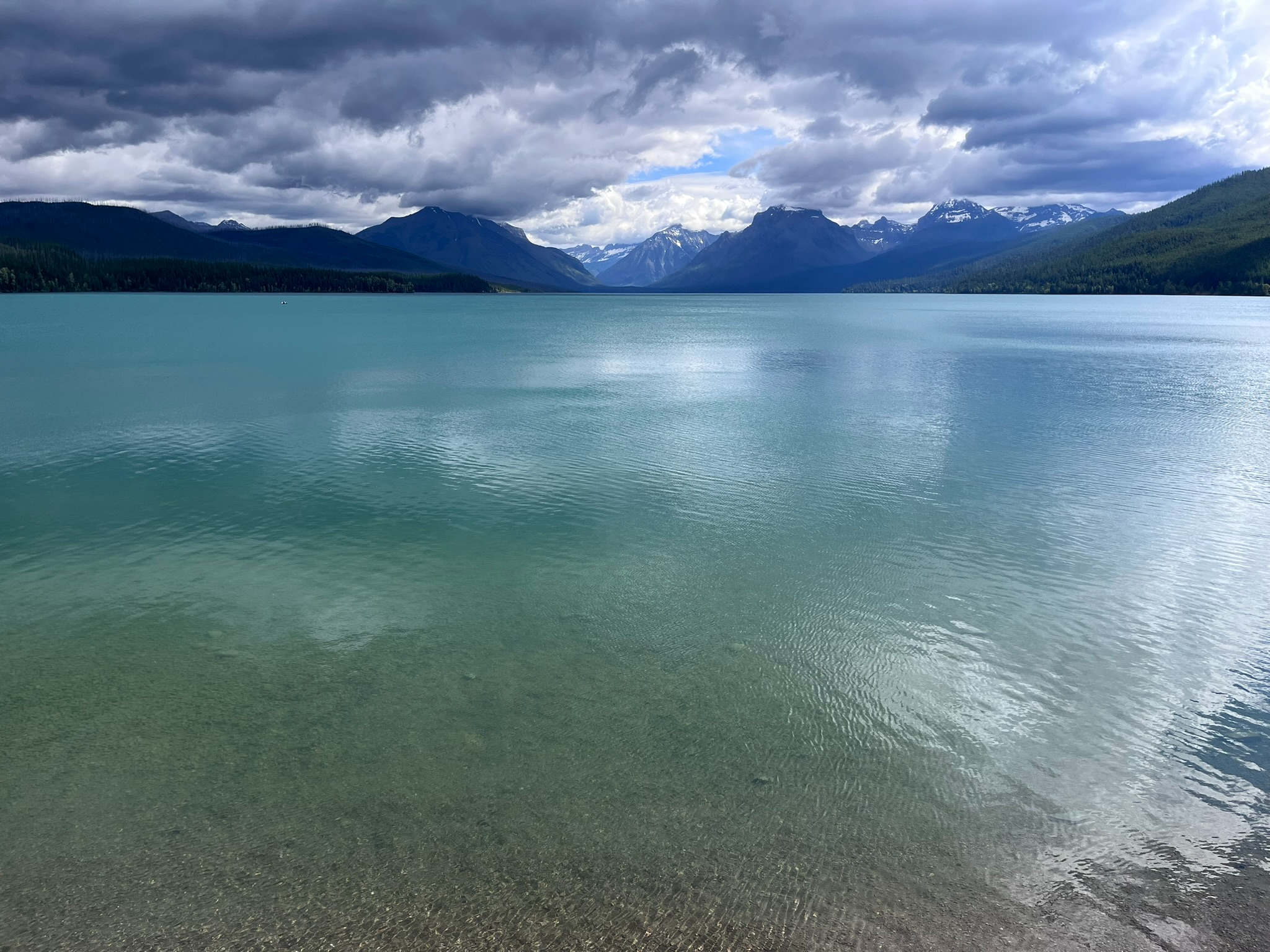
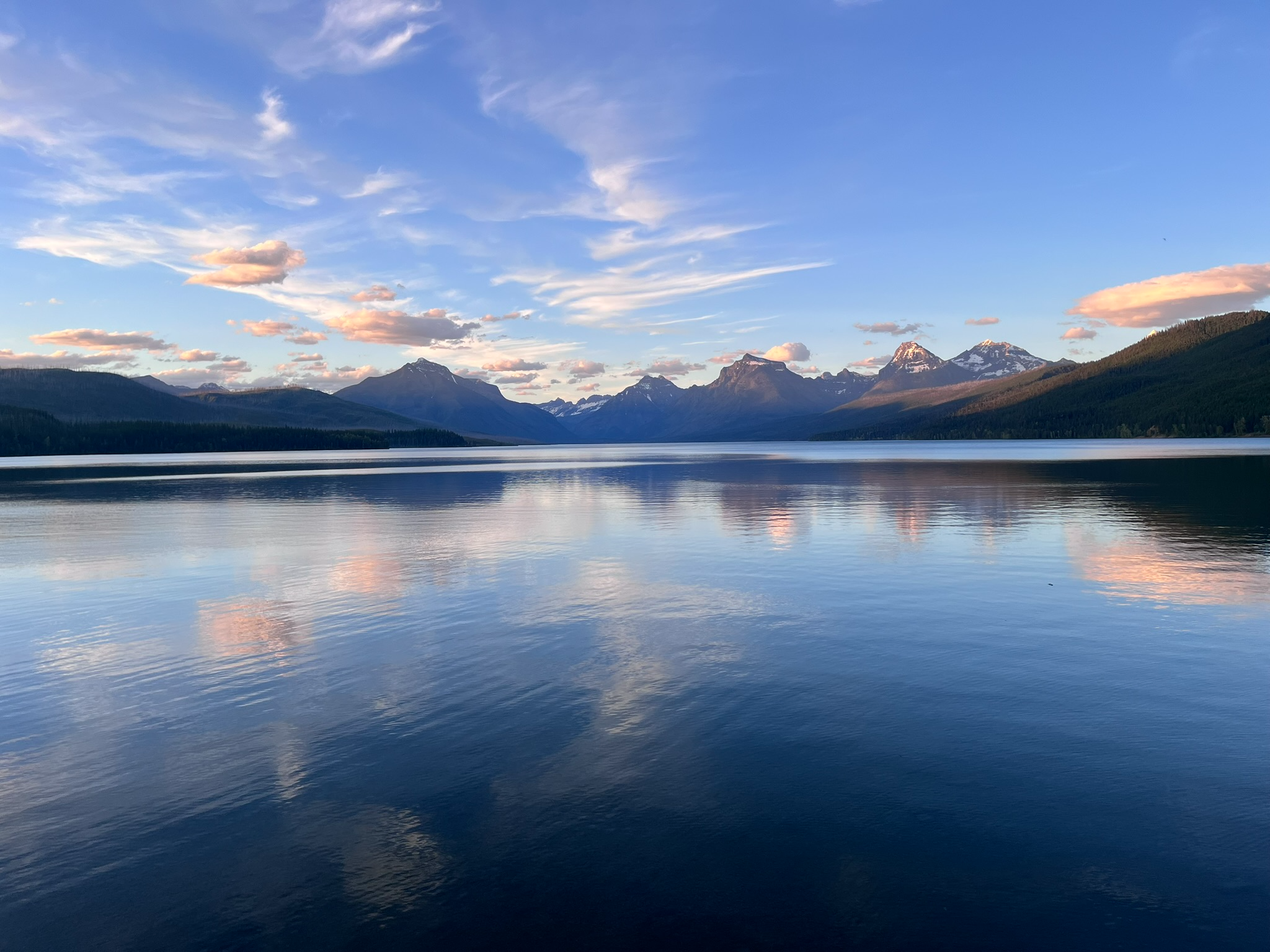
Something amazing happened when I first saw the view of Lake McDonald from the Village Inn at Apgar. All sense of linear time and arbitrary borders left my mind and I felt I was breathing in the same air that was here when these mountains and lakes took on close to their current form at the end of the last ice age. This is the same lake that the first humans witnessed 10,000-12,000 years ago as the Ice Age glaciers retreated and humans first settled the area. Perhaps Anzick boy’s relatives fished here as Clovis culture people roamed the area hunting bison. The Anzick child, the oldest human remains found in North America, was found just a few hundred miles from here, well within range of a nomadic society.
I thought of how this lake must have looked similar to the Kootenai, Salish, and Pend d’Orielle people who have lived here for thousands of years. When Sumeria was formed in Mesopotamia (which we all learn about in school), the ancestors of today’s Indigenous Americans were living here.
More recently, when the first French fur trappers arrived, did they see beauty or danger or money or all of these? Did conservationist George Bird Grinnell have this sense of timelessness when he denominated the area as “The Crown of the Continent” and wrote his articles about the area that helped convince Theodore Roosevelt and others that the area should be preserved from logging and mining?
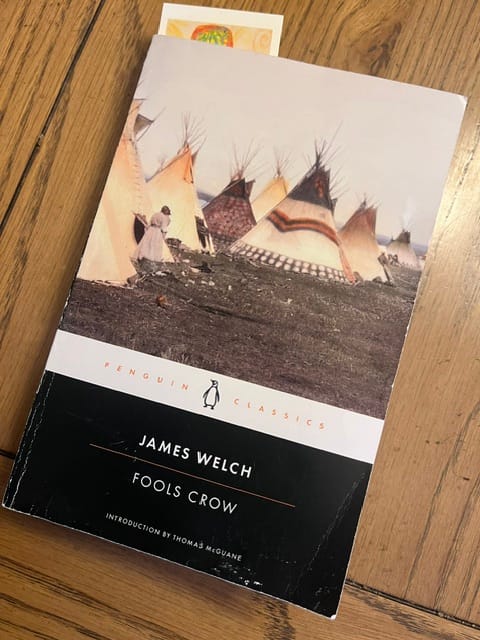
This feeling of communing with humans across time was deepened as I read the book Fools Crow by James Welch, a Blackfoot writer, who wrote this fictional account of what it was like to live during the time of European conquest in the 1870s. Entering the west side of the park, traditional home of the Blackfoot people, requires driving through the town of Two Medicine and the Blackfoot Reservation, important reminders that people lived in what is now the park for many generations. Before glaciers had names like Grinnell and Jackson, Blackfoot people must have watched them grow and shrink as they fished lakes that now have names like Swiftcurrent and St. Mary’s.
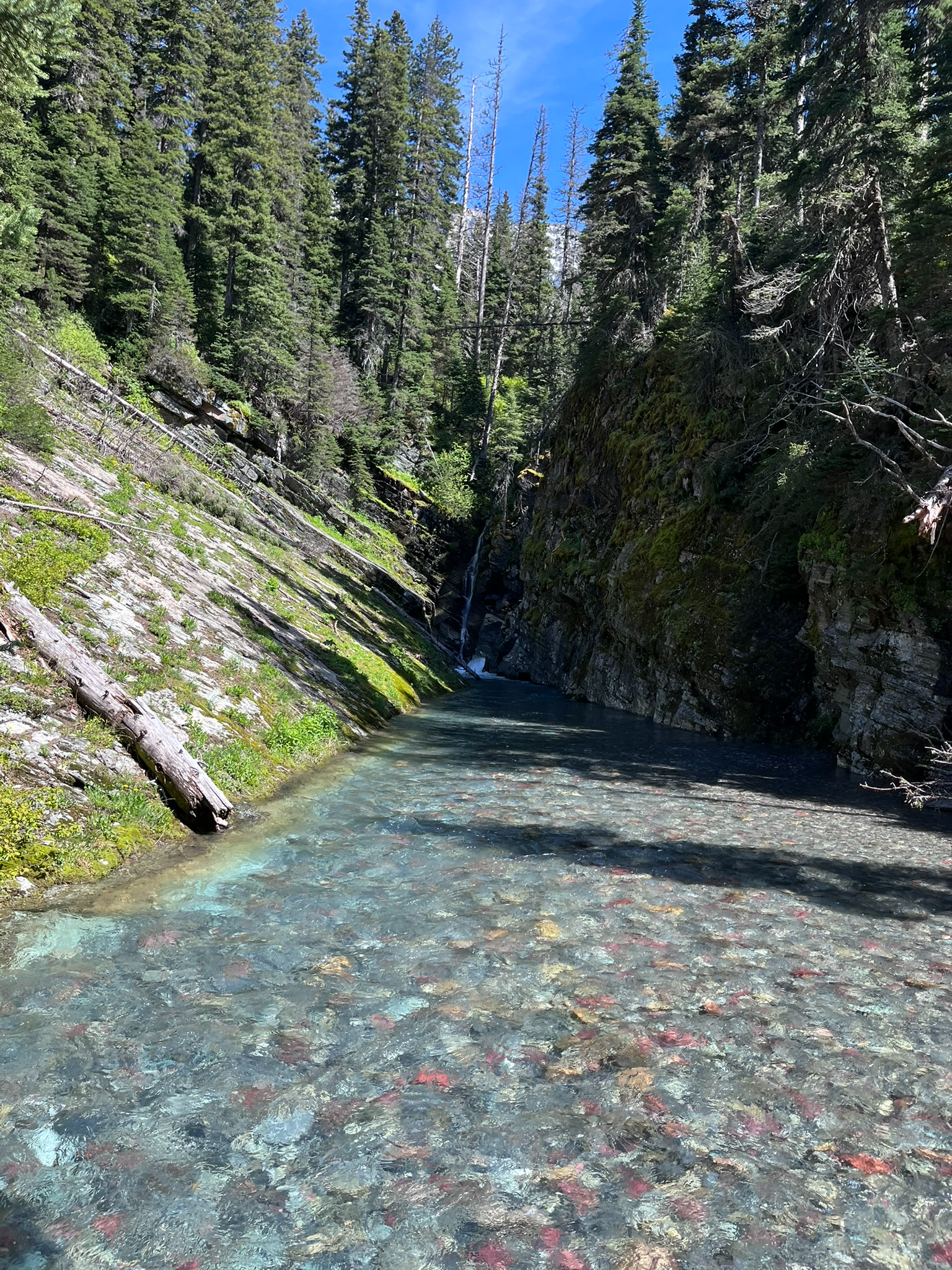
What a joy to marvel at the clearness of the water and the amazingly colorful stones that have inspired awe for over ten millennia, it is amazing to think about what has happened as these mountains watched, as these trees have grown, as the precursors of the bison, bears, wolves, deer, wolverines, and other wildlife roamed these lands.
Lodging in the Park
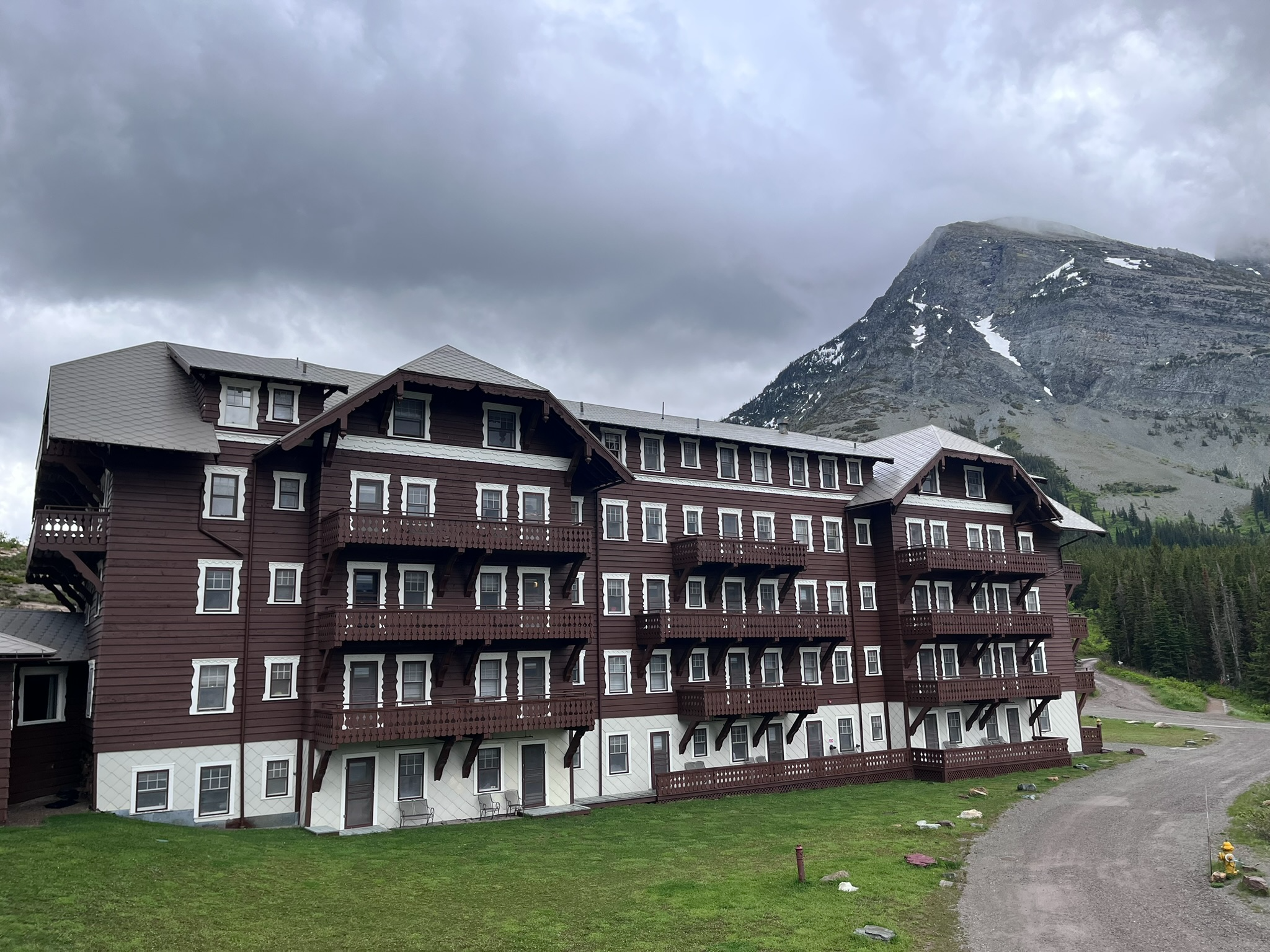
It was early season when we were in the park in mid-June. Going-to-the-Sun Road was not fully open yet, and many trails were still significantly snow-covered. One day we had cold, torrential rain which is typical for this early spring season. Our first two nights, we stayed in the Village Inn at Apgar on the west side and the second two nights we stayed at Many Glacier Lodge. We were at the latter lodge on the second day they were open for the season and took the first ranger tour of the lodge of the season.
It is always wonderful to stay inside a national park and experience the nighttime sounds and see the stars, but staying inside Glacier National Park with the serene settings of our lodging was particularly special. The Village Inn at Apgar is a renovated motor lodge style hotel with perhaps the best view in the universe, and although basic has a fun mid-20th century vibe. The Many Glacier Lodge is classic parkitechture and the second lodge to open in the park in 1913, including having no elevator, windows that open, and two-tap sinks and a claw-foot tub.
Enjoying the Park
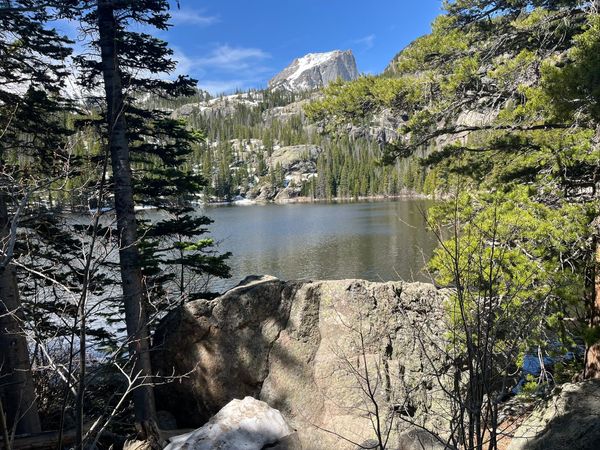
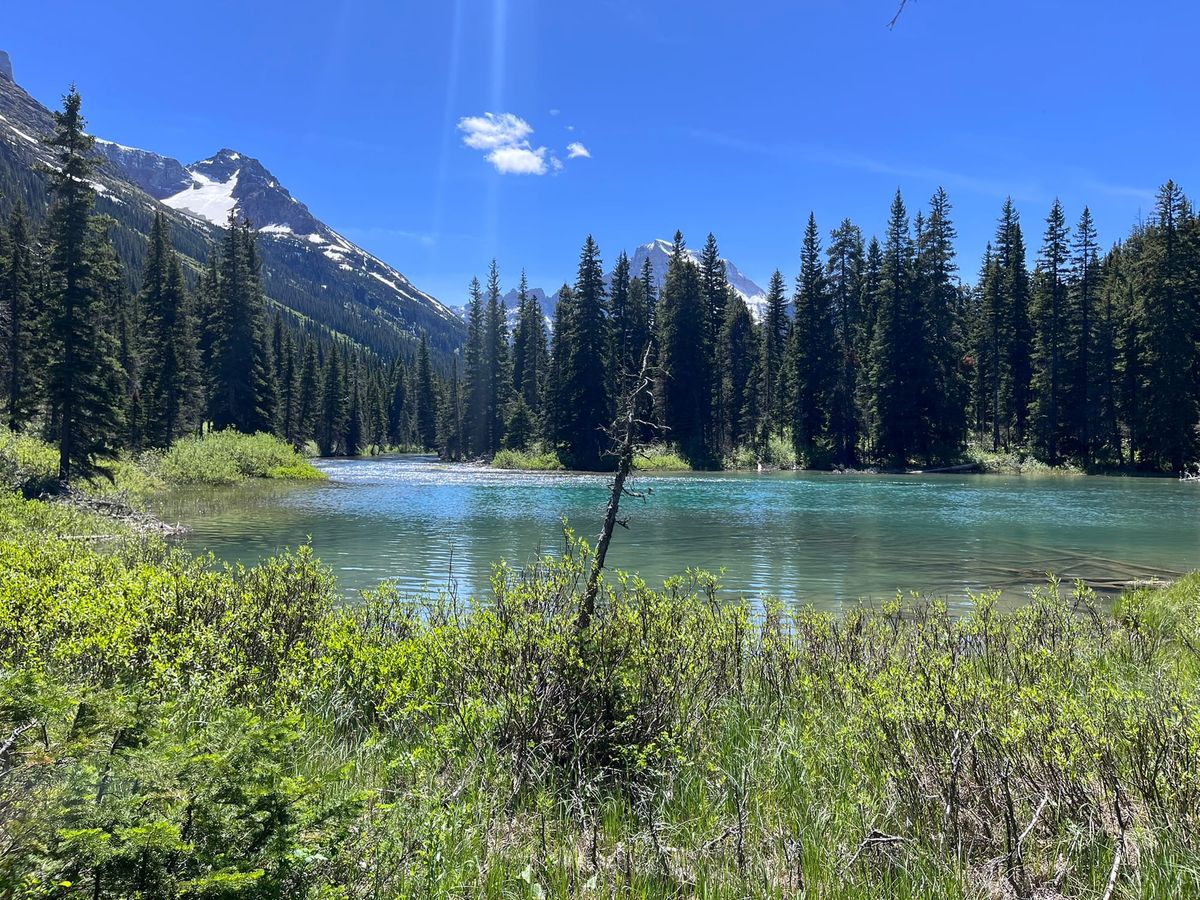
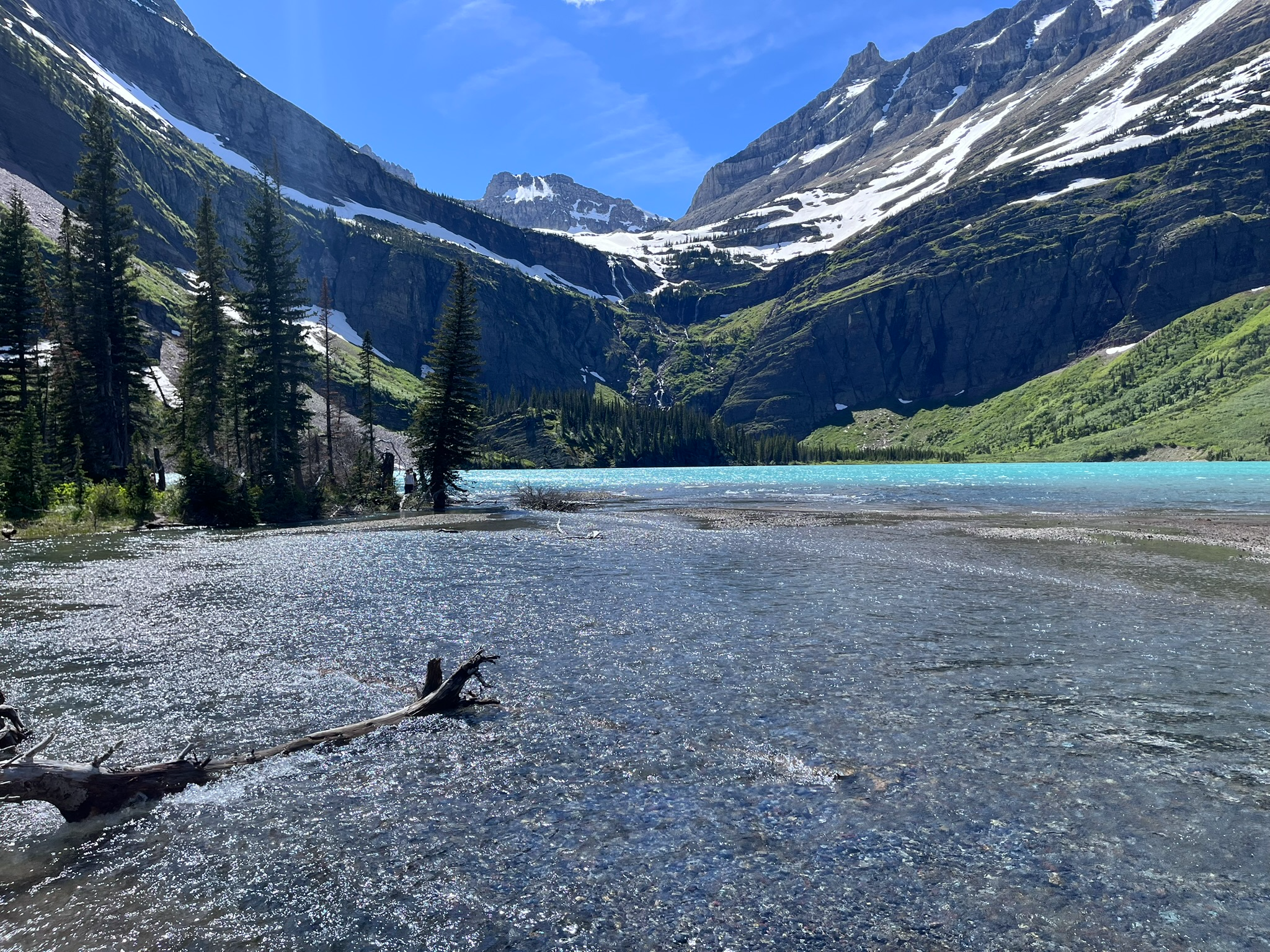
There is nothing quite like hiking with a glacial lake as the big payoff, and there are so many opportunities to do this in GNP. On the west side, we hiked to John’s Lake and the various other trails that connect to it. After several tries at getting a parking space, we were fortunate to hike to Avalanche Lake. On the east side, we were able to see Shurburne and Swiftcurrent Lakes without really hiking at all, and enjoyed the hike to Lake Josephine and the quite beautiful Grinnell Lake. It was too early in the season and snow-covered for us to go beyond Grinnell Lake, although some more intrepid hikers did so. In addition to lakes, we also caught the beautiful Apukuni Falls and Hidden Falls.
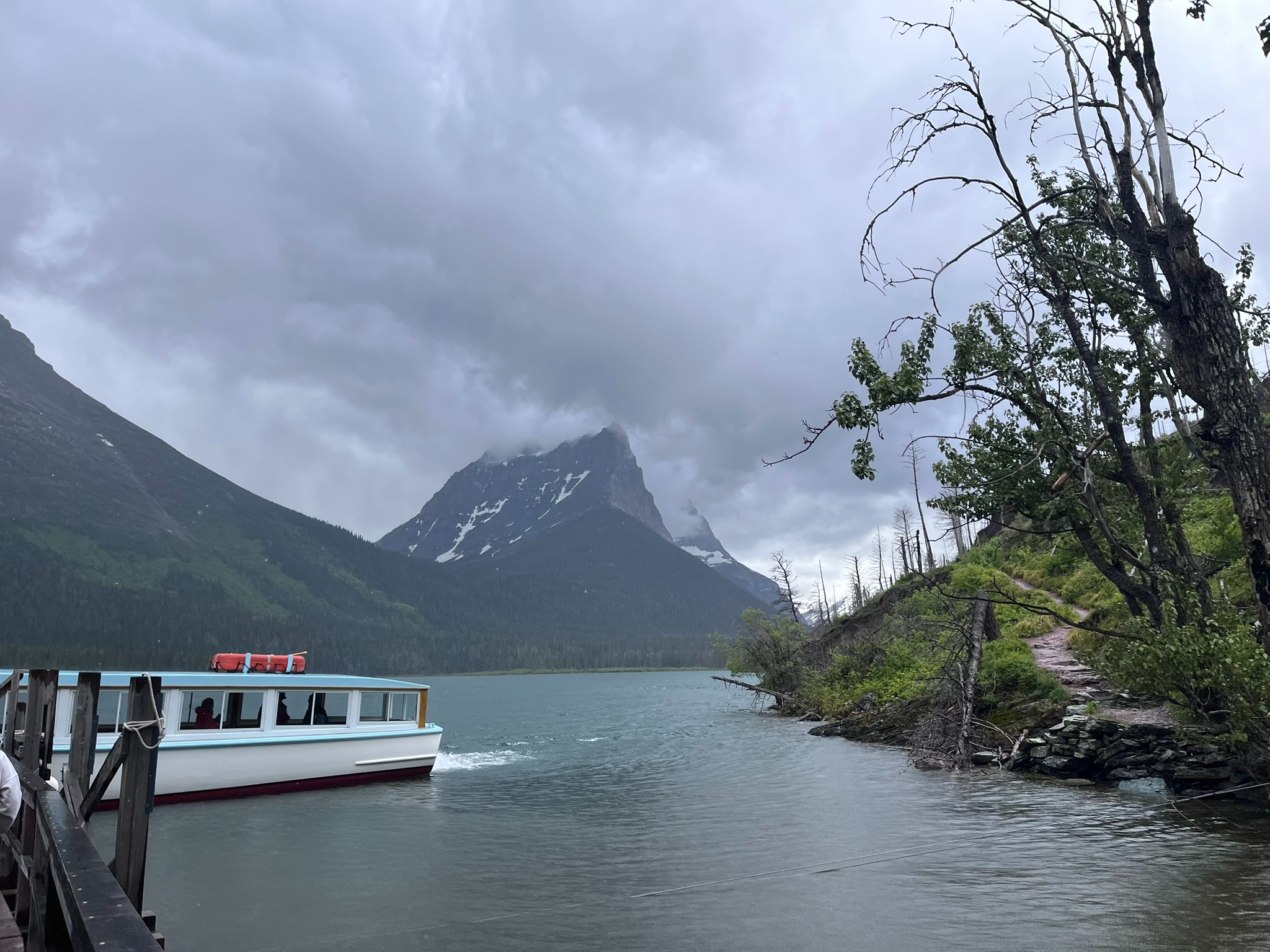
Not up for hiking? Our boat tour of St. Mary’s Lake on the historic Little Chief boat was a highlight of the trip, despite the cold rain, and the brief walk to Baring Falls was a beautiful leg stretcher before we got back in our car to start the long journey home.
One of the things that made the park a deeper experience for me was thinking about the history and origins of the area as we were experiencing it.
How did Glacier National Park Come to Be?
How and why did Glacier National Park become a national park? How did the relatively unspoiled beauty survive so many years of human habitation and visiting and why did the need to protect it arise?
The process of U.S. claim to the area began in 1855 as the United States began to take a greater interest in this western part of the continent. Very early settlers and fur traders aligned with the tribes on the west side of the park, with the settlers trading with the long-term residents and the Kootenai, Salish, and Pend d’Orielle hoping that by aligning with the powerful Europeans and Americans that they would be protected against their traditional enemies, the Blackfeet, who were living in what is now the eastern side of the park.
Under pressure, the tribes signed the Hellgate Treaty in 1855, which has been much criticized for being poorly understood by both sides due to translation issues. The tribes agreed to cede land to the United States in exchange for annual payments and military protection from the Blackfeet and restrictions on U.S. settlement on their lands; the military protection and restrictions on settlement never came and it took Congress four years to ratify the treaty, delaying payment for four years. Once payment came, it was in the form of goods like blankets and food rather than in cash. The Kootenai and the Pend d’Orielle voluntarily moved to the Flathead Reservation, and the Salish were forced to do so after their rights to remain living in the Bitterroot Valley were denied.
The United States was distracted from western interests during the Civil War, but after the Civil War, settlers began pouring westward. After the war, the U.S. began the war against Indian tribes of the west in earnest, and the Blackfeet people on the eastern side of what is now the park was decimated by the intentional killing off of bison to deprive them of food, small pox, and battle with the U.S. and found the much-decimated population starving by 1895. The U.S. government approached the tribe with a treaty to purchase what is now the eastern side of the park, with the intent of mining there. Initially, the Blackfeet refused the U.S., then requested $3 million for the land. Later, in duress, the Blackfeet signed a treaty to allow the U.S. to claim the land for $1.5 million, but retaining hunting, fishing, and foraging rights to the land. Conservationist George Bird Grinnell helped convince the Blackfeet that this was their only means of survival. The United States and the state of Montana quickly reneged on Native rights to access the land and meted out annual payments slowly in a way that kept the people dependent on the U.S.
Once the U.S. claimed the land, George Bird Grinnell, sought to convince the United States to preserve the land and the endangered bison, writing frequent articles in the magazine Forest and Stream and lobbying his influential friends, including Theodore Roosevelt, who were part of the Boone and Crockett Club, a group who hunted, fished, and pursued hobbies which were seen as “manly” actions of frontier men.
Grinnell teamed up with railroad magnate Louis Hill, owner of the Great Northern Railway, to convince Congress to turn the land into a national park. Hill envisioned the park as a profitable tourist spot and marketed it to convince wealthy Americans to “see America first” via railroad, rather than sailing abroad, as the country expanded. These efforts were successful and Glacier National Park was created in 1910, with the first national park lodge built in the park by the railroad company in 1913.
For thousands of years, people lived and roamed the area that is now Glacier National Park, and the area was abundant with fish, wildlife, berries, nuts, and other forms of sustenance. Once fur traders moved in, both Europeans and Indigenous people began over-hunting to supply the insatiable appetites for furs in Europe and Asia. Europeans (and later Americans) made money and gained land while Indigenous people traded for in-demand items such as guns, knives, and other items on offer. The escalation of weapons further threatened the sustainability of wildlife populations.
After the Civil War, the U.S. intentionally sought to eradicate bison as a means of destroying the food source of Indian tribes and eliminating their reasons for wanting to roam wide expanses of land to hunt. As more people moved westward, and as railroads expanded, the area was in demand for logging and mining.
At this point, George Bird Grinnell and others realized some very important people, landscapes, and animals were going to be lost and sought to preserve the area. We are very fortunate that they were able to do so, as the area most certainly never would have recovered from logging, mining, and continued over-hunting. However, this preservation came at a high cost to the Indigenous people who stewarded the land for thousands of years, whose descendants now live on the reservations surrounding the national park.
The Timeless Beauty of Glacier National Park
Looking out at Lake MacDonald from the Apgar, I see the beauty of a lake that humans have been looking at for thousands of years. I see my own children paddleboarding on the lake and think about the many, many generations of children who have set out on the lake. I see the parents who have watched them from shore, hoping for their safety, and feeling gratitude for the crisp, clean air, the stunningly-clear water, and the majestic mountain backdrop.